
Restorative dentistry involves much more than placing restorative material.
Dentists must prepare, adapt, condense, contour, sculpt and finish restorations with a high level of control.
This is why restorative dental instruments are available in many different working-end shapes.
Composite instruments, condensers, burnishers and carvers each perform different tasks.
For distributors and dental brands, understanding these differences is important when developing a professional restorative instrument portfolio.
What Are Restorative Dental Instruments?
Restorative dental instruments are hand tools used during operative and restorative procedures.
They may be used for cavity preparation, composite placement, material condensation, anatomical contouring and finishing.
Many restorative instruments are double-ended, allowing two working ends to be combined on one handle.
Composite Placement Instruments
Composite instruments are designed for placing, adapting and shaping restorative materials.
Their working ends may be flat, paddle-shaped or specially angled.
Different geometries allow clinicians to reach different areas of the restoration.
When evaluating composite instruments, buyers should consider working-end thickness, angle, surface finish and handle grip.
Dental Condensers
Condensers, also called pluggers in some product ranges, feature compact working ends.
They are designed for controlled placement and condensation of restorative materials.
Different working-end diameters can be offered to suit different procedures.
Manufacturers may combine two sizes on one double-ended instrument.
Dental Burnishers
Burnishers typically have smooth, rounded working ends.
They are used for contouring and refining restorative materials.
Ball burnishers and other shapes can be produced according to product requirements.
The surface finish of the working end is especially important because rough areas may affect the final instrument quality.
Dental Carvers
Carvers are used for shaping restorative material and reproducing anatomical form.
Different carver designs have different blade or tip shapes.
Fine working ends require careful grinding and finishing.
For private-label buyers, multiple carver models can be organized into a complete restorative range.
Cavity Preparation Instruments
Operative dentistry may also use chisels and specialized preparation instruments.
These instruments have controlled cutting or shaping ends.
Different angles and widths may be required.
For OEM projects, precise reference samples are recommended.
Anterior and Posterior Restorative Instruments
Not every restorative instrument is designed for the same area.
Anterior restorations may require fine instruments for aesthetic shaping.
Posterior restorations may require stronger or differently angled working ends.
Distributors can therefore organize product ranges by procedure type rather than only by instrument name.
Working-End Geometry
The working end is one of the most important elements of a restorative instrument.
Even a small difference in angle, width or thickness can change its use.
When developing an OEM product, the customer should confirm:
tip shape, tip width, tip thickness, shaft angle, overall length and handle style.
Drawings and samples can help avoid misunderstandings.
Handle Design
Restorative procedures require controlled hand movements.
A textured handle can provide grip, while handle diameter affects instrument balance.
Some distributors prefer one handle style across the entire restorative range.
This creates consistent branding and simplifies product photography.
Stainless Steel Construction
Professional restorative hand instruments are commonly produced from stainless steel.
However, material selection should match the product specification and intended use.
Surface finishing is also important.
The working ends and handle should have a consistent professional appearance.
Building a Restorative Instrument Kit
Restorative instruments are well suited to complete procedure sets.
A kit may include:
composite placement instrument, condenser, burnisher, carver, cavity preparation instrument and cassette.
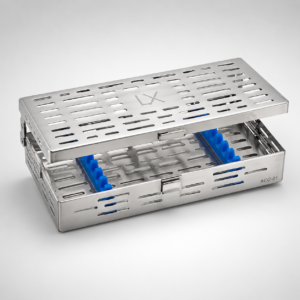
The cassette helps organize the instruments into one product package.
Internal link:https://lxdent.com/accessories-cassettes/
OEM and Private Label Restorative Instruments
Dental distributors can develop customized restorative ranges.
Possible options include:
custom working ends, logo laser engraving, handle design, model numbers, complete instrument sets and packaging.
If a distributor already sells an established instrument style, a physical reference sample can help communicate the desired design.
Quality Control
Restorative instruments require consistent working ends.
Quality control can include checking:
dimensions, tip geometry, shaft alignment, polishing, handle texture, laser marking and overall appearance.
For double-ended instruments, both ends should be inspected.
Frequently Asked Questions
What are common restorative dental instruments?
Composite placement instruments, condensers, burnishers and carvers are common categories.
Are restorative and operative instruments the same?
The terms overlap significantly. Operative instruments are commonly used during cavity preparation and restorative procedures.
Can restorative instruments be customized?
Yes, depending on manufacturing feasibility.
Can they be supplied as sets?
Yes. A cassette can be configured for multiple restorative instruments.
Conclusion
Restorative dental instruments are essential for controlled material placement, shaping and finishing.
The correct working-end geometry can make each instrument suitable for a specific stage of the restorative procedure.
For distributors, a structured range of composite instruments, condensers, burnishers and carvers creates strong product coverage.