
How to Choose Stainless Steel Dental Instruments: A Buyer’s Guide
Stainless steel dental instruments are widely used in professional dentistry because they combine precision, mechanical strength and a surface suitable for repeated clinical handling.
However, not all stainless steel dental instruments are produced to the same standard.
For dentists, differences in working-end design or handle quality can affect usability. For dental distributors and private-label brands, inconsistent manufacturing can create even larger problems because product quality must remain stable across multiple production batches.
This buyer’s guide explains what professional purchasers should evaluate before selecting a dental instrument supplier.
Why Is Stainless Steel Used for Dental Instruments?
Dental instruments require a material capable of maintaining precise shapes while also providing sufficient strength for professional use.
Stainless steel is commonly selected because it can be machined, shaped and polished into the fine geometries required for dental hand instruments.
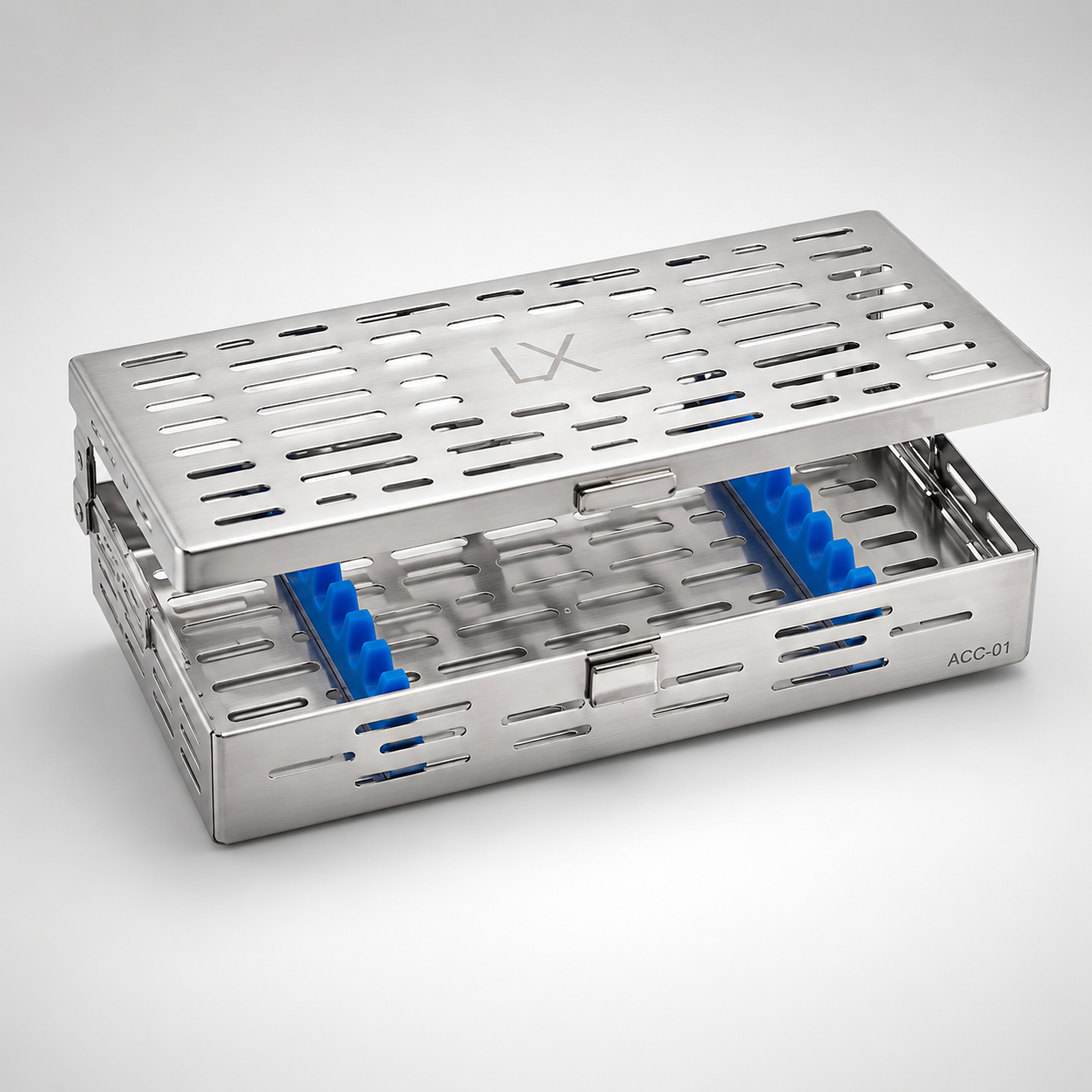
Different instruments may require different material characteristics. A fine explorer tip, extraction forceps and a stainless steel cassette do not necessarily require identical manufacturing approaches.
Therefore, buyers should evaluate the final product rather than simply asking whether an instrument is “stainless steel.”
Check the Working-End Precision
The working end is often the most important part of a dental instrument.
For example:
An explorer requires a fine and consistent tip.
A restorative instrument may require controlled flat, rounded or angled working ends.
A surgical forceps requires accurately shaped gripping surfaces.
A dental chisel requires a controlled cutting or shaping geometry.
When examining samples, buyers should compare several pieces rather than inspecting only one instrument.
Consistent geometry across multiple samples is a useful indicator of manufacturing control.
Evaluate Surface Polishing
Surface finishing affects both appearance and product consistency.
Poor polishing may leave visible marks, uneven surfaces or rough transitions.
Professional polishing should create a clean, uniform appearance while preserving the intended working-end geometry.
For B2B buyers, surface consistency is particularly important because private-label products should look similar from one batch to the next.
Inspect the Handle Design
A dental instrument handle should provide sufficient grip and control.
Common handle features include knurled areas, textured patterns, ergonomic contours and smooth central marking zones.
The correct handle depends on the clinical application.
When evaluating a sample, consider:
- overall diameter;
- surface texture;
- balance;
- weight;
- transition between handle and working end;
- engraving area.
If you are developing a private-label range, handle consistency also influences overall brand appearance.
Check Hinges and Moving Parts
Hinged dental instruments require additional inspection.
Examples include extraction forceps, surgical scissors and needle holders.
Check whether the hinge moves smoothly and whether the two sides align correctly.
For needle holders or locking instruments, the mechanism should engage consistently.
For scissors, blade alignment is especially important.
These details cannot be evaluated by looking only at product photographs.
Sample inspection is recommended before a large OEM order.
Consider Working-End Strength
Some dental instruments use very fine working ends.
Precision is important, but the tip also needs to match the intended application.
The manufacturer should control geometry, thickness and finishing according to the agreed product specification.
For custom projects, buyers should provide clear dimensions, reference samples or technical drawings where possible.
Look at Laser Marking Quality
Private-label dental instruments often include company logos or model numbers.
Laser engraving should be positioned consistently and remain visually clear without creating unnecessary surface damage.
When developing a branded product range, consider defining:
- logo position;
- logo size;
- model number;
- product code;
- font;
- marking direction.
A consistent marking standard improves the appearance of the complete product portfolio.
Inspect Instrument Sets as a System
If you are purchasing complete dental instrument sets, do not evaluate each tool independently.
The instruments should also fit correctly within the chosen cassette or organizer.
Consider:
- cassette dimensions;
- number of instruments;
- spacing;
- silicone holder positions;
- instrument length;
- arrangement;
- closure clearance.
A well-designed set should be organized and practical.
Ask About Quality Control
Professional dental instrument sourcing should include clear inspection procedures.
Typical control points may include:
- material inspection;
- dimensional checks;
- working-end inspection;
- surface finishing;
- hinge or joint inspection;
- logo marking;
- final visual inspection;
- packaging checks.
For large projects, discuss acceptable specifications before production begins.
Request Samples Before Bulk Purchasing
For B2B purchasing, samples are one of the most valuable tools for evaluating a supplier.
A sample allows the buyer to inspect:
- finish;
- grip;
- weight;
- tip geometry;
- movement;
- engraving;
- overall quality.
If the project involves customization, sampling also helps confirm the design before mass production.
Think Beyond One Product
A supplier that manufactures only one or two products may be suitable for specialized sourcing.
However, dental distributors often benefit from a manufacturer covering multiple instrument categories.
For example, one sourcing program might include:
Diagnostic Instruments
Endodontic Instruments
Restorative Instruments
Surgical Instruments
Specialized Instruments
Instrument Cassettes
A broader product range may simplify product development and consolidation.
Private Label and OEM Considerations
If your goal is to create your own dental brand, ask whether the manufacturer supports OEM or ODM development.
Possible services may include:
custom working ends, handle configuration, logo laser engraving, product codes, custom sets, cassette layouts and packaging.
Provide as much technical information as possible when requesting a quotation.
Questions to Ask a Dental Instrument Manufacturer
Before placing an order, ask:
What instrument materials are available?
Can you provide a sample?
Can the working ends be customized?
Can our logo be laser engraved?
Can multiple products be combined into one set?
Can cassette layouts be customized?
Can packaging be private labeled?
What information is required for production approval?
These questions help reduce misunderstandings during the sourcing process.
Conclusion
Choosing stainless steel dental instruments should involve more than comparing prices.
Professional buyers should evaluate material suitability, working-end precision, surface polishing, handle design, joint quality, engraving and production consistency.
For distributors and private-label brands, the manufacturer’s ability to support samples, customization and multi-category sourcing is also important.